AES
AES is a symmetric block cipher, which means that it uses the same key to encrypt and decrypt. It encrypts exactly 16 bytes (128 bits) at a time, this is the same for all key sizes.
AES-128 –> 10 Rounds
AES-192 –> 12 Rounds
AES-256 –> 14 Rounds
Initial States
A block is represented as a 4 by 4 matrix:
\[\begin{bmatrix} \text{b0} \ \text{b4} \ \text{b8} \ \text{b12} \\ \text{b1} \ \text{b5} \ \text{b9} \ \text{b13} \\ \text{b2} \ \text{b6} \ \text{b10} \ \text{b14} \\ \text{b3} \ \text{b7} \ \text{b11} \ \text{b15} \\ \end{bmatrix}\]Each byte is represented as an element in \(\text{GF}(2^8)\) or as a polynomial with a degree less than 8 with binary coefficients.
For example: \(0x57 = 01010111 = x^6 + x^4 + x^2 + x + 1\)
Operations
All operations are done under modulo \(x^8 + x^4 + x^3 + x + 1\) or 0x11B which is an irreducible polynomial. Addition in \(\text{GF}(2^8)\) is XOR operation. Multiplication in \(\text{GF}(2^8)\) is polynomial multiplication.
Key Schedule
The Key Expansion Algorithm takes in 16 byte key (For AES-128) and expands it into 11 16 byte keys, total of 176 bytes.
The initial input key is also known as the Master Key which is the given unexpanded key.
Key Expansion Algorithm:
\(\text{Key 1} = \text{Key Expansion}(\text{Master Key})\)
\(\text{Key 2} = \text{Key Expansion}(\text{Key 1})\)
\(\dots\)
\(\text{Key 11} = \text{Key Expansion}(\text{Key 10})\)
\(\text{Input Key} \rightarrow \text{S-Box}(\text{rotl}(\text{Input Key})) \oplus \text{RConst}[i] \rightarrow \text{Output Key}\)
\(\text{RConst}\) is an array of constant bytes, and \(i\) is dependent on the Input Key’s index.
For the following examples:
Master Key = \(\text{W}[0] || \text{W}[1] || \text{W}[2] || \text{W}[3]\)
\(\text{W}[3] = \text{AF 7F 67 98}\)
For \(W[i]\) where \(i \equiv 0 \pmod{4}\):
\(\text{W}[i] = \text{W}[i - 4] \oplus \text{S-Box}(\text{rotl}(\text{W}[i - 1])) \oplus \text{RConst}[i \div 4]\)
For \(\text{W}[i]\) where \(i \not\equiv 0 \pmod{4}\):
\(\text{W}[i] = \text{W}[i - 4] \oplus \text{W}[i - 1]\)
Rotate Left \((\text{rotl})\)
A left cyclic rotation of the initial key
\(\text{rotl}(\text{Master Key}) = \text{7F 67 98 AF}\)
RConst
\(\text{RConst} = [\text{01, 02, 04, 08, 10, 20, 40, 80, 1B, 36}]\)
\(\text{RConst}[i - 1]\) is XORed with the \(1\)st bytes of the $i$th iteration of the algorithm.
SubBytes (S-Box)
SubBytes takes an input byte and looks it up in the S-Box which is a precomputed look-up table and replace the input byte with its corresponding byte in the lookup table.
S-Box
S-Box is a look up table which stores the output of this following function: \(\text{S}(\text{b}) \rightarrow \text{b}^{-1} \oplus \text{rotl1} \oplus \text{rotl2} \oplus \text{rotl3} \oplus \text{rotl4} \oplus \text{0x63}\), where rotl stands for Rotate Left and rotates \(\text{b}^{-1}\) by given number of bits. \(\text{b} \cdot \text{b}^{-1} \equiv \text{0x01} \pmod{\text{0x11B}}\). Define \(0^{-1} \equiv 0 \pmod{\text{0x11B}}\).
ShiftRows
Row r of the current state is rotated left by r bytes:
\[\begin{bmatrix} \text{s0} \ \text{s4} \ \text{s8} \ \text{s12} \\ \text{s1} \ \text{s5} \ \text{s9} \ \text{s13} \\ \text{s2} \ \text{s6} \ \text{s10} \ \text{s14} \\ \text{s3} \ \text{s7} \ \text{s11} \ \text{s15} \\ \end{bmatrix} \rightarrow \begin{bmatrix} \text{s0} \ \text{s4} \ \text{s8} \ \text{s12} \\ \text{s5} \ \text{s9} \ \text{s13} \ \text{s1} \\ \text{s10} \ \text{s14} \ \text{s2} \ \text{s6} \\ \text{s15} \ \text{s3} \ \text{s7} \ \text{s11} \\ \end{bmatrix}\]MixColumns
MixColumns are calculations done to every single column by assigning a new value to each byte in a column dependent on the initial value of every element in each column.
\[a^{'}_0 = 2\text{a}_0 \oplus 3\text{a}_1 \oplus 1\text{a}_2 \oplus 1\text{a}_3 \newline\] \[a^{'}_1 = 1\text{a}_0 \oplus 2\text{a}_1 \oplus 3\text{a}_2 \oplus 1\text{a}_3 \newline\] \[a^{'}_2 = 1\text{a}_0 \oplus 1\text{a}_1 \oplus 2\text{a}_2 \oplus 3\text{a}_3 \newline\] \[a^{'}_3 = 3\text{a}_0 \oplus 1\text{a}_1 \oplus 1\text{a}_2 \oplus 2\text{a}_3 \newline\]AddRoundKey
We can obtain each Round’s Key from the Key Schedule, then simply XOR the 16-byte state byte by byte with the current round’s key, where the first round’s key is the Master Key.
Full Encryption Algorithm
1 Round: SubBytes -> ShiftRows -> MixColumns -> AddRoundKey
Initial State of 16-bytes -> AddRoundKey -> 9 Rounds -> ShiftRows -> MixColumns -> AddRoundKey -> Output.
AES-ECB
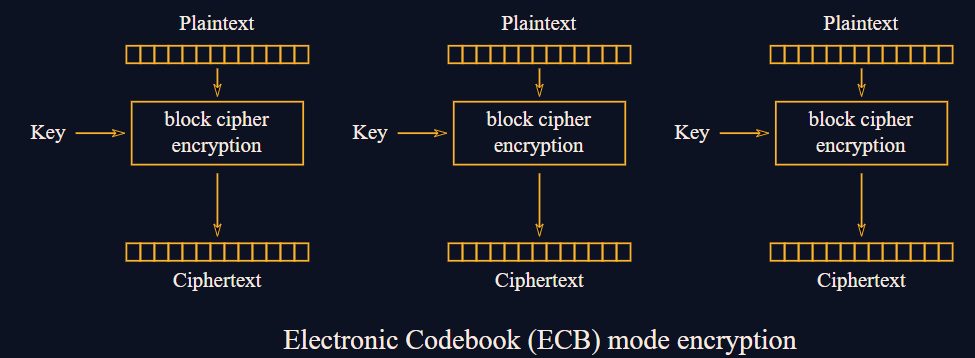
AES-ECB works by padding the initial plaintext till block length, split it up into equal blocks and encrypts all of them using the same key. It then concatenates the resultant ciphertexts back together. This mode of AES does not use an IV or Nonce.
Vulnerabilties
Bytes at a Time ECB Decryption
Byte-at-a-time ECB Decryption is a form of vulnerability in AES-ECB encryption algorithms, it uses a Chosen Plaintext Attack (CPA) in order to directly obtain the plaintext.
As AES-ECB encryption’s nature make it such that every single block is independently encrypted, we can slowly extract the original plaintext if we are able to append our own custom plaintext in front of the original plaintext in order to cleverly recover the original plaintext.
DEMO FLAG: FLAG{ghx312ghx312}
As AES-ECB encrypts in 16 byte blocks, we can split up and see the original blocks that will initially be encrypted.
Block 1: FLAG{ghx312ghx31
Block 2: 2}
We can use our ability to concatenate padding to the front of the plaintext before it encrypts in order to recover the original plaintext, one byte at a time.
Block 1: AAAAAAAAAAAAAAAX
Block 2: AAAAAAAAAAAAAAAF
Block 3: LAG{ghx312ghx312
Block 4: }aaaaaaaaaaaaaaa
As we know the first 15 characters of the first 2 blocks, we can simply guess X until the first 2 blocks matches.
Block 1: AAAAAAAAAAAAAAFX
Block 2: AAAAAAAAAAAAAAFL
Block 3: AG{ghx312ghx312}
After guessing the first block of the flag, we can use the above method in order to compare the bytes between the first block and the third block in order to guess the bytes inside the second block of the flag.
For example:
\(\text{CT}_1 = \text{AES}(\text{admin=})\)
\(\text{CT}_2 = \text{AES}(\text{True: Apples fall})\)
What we can do is, assuming that both blocks are fully padded, we can concatenate the ciphertexts together in order to obtain
\(\text{AES}^{-1}(\text{CT}_1 \vert\vert \text{CT}_2) \rightarrow \text{admin=True: Apples fall}\). The machine will then parse \(\text{admin = True}\) and elevate our status.
AES-CBC
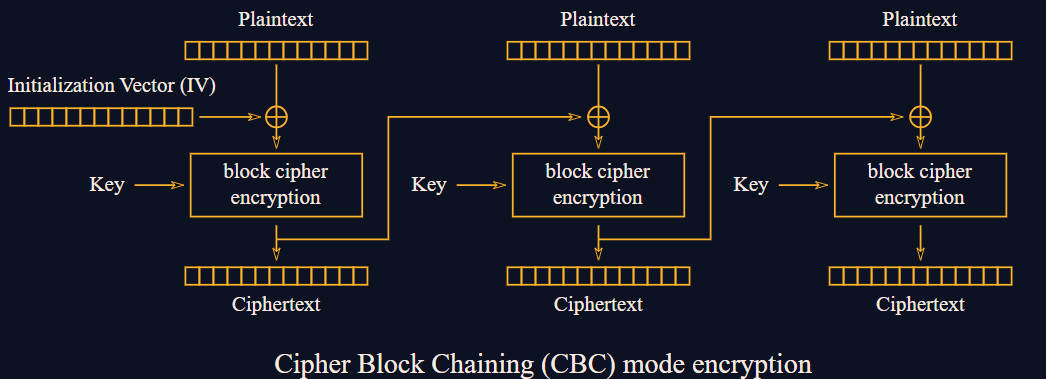
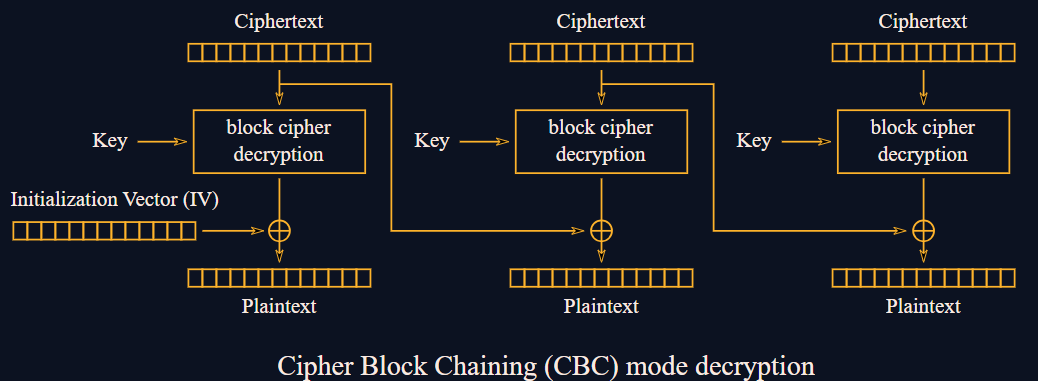
AES-CBC works by initially padding the intial plaintext to block length, splitting it up into blocks. It then chooses a nonce or IV which is a random string of 16 bytes that will only be used once. We then XOR the first block with this nonce before encrypting as per normal with our key. This resultant encrypted block is then XORed with the next block’s plaintext before encrypting it as per normal.
Encryption
Generally, encryption for the first block:
\(\text{ENC0} = \text{AES}(\text{PT0} \oplus \text{IV})\)
Encryption for each subsequent block:
\(\text{ENCX} = \text{AES}(\text{PTX} \oplus \text{ENC(X - 1)})\)
Note: Encryption is not parallelizable
Decryption
Generally, decryption for first block:
\(\text{PT0} = \text{AES}^{-1}(\text{ENC0}) \oplus \text{IV}\)
Decryption for each subsequent block:
\(\text{PTX} = \text{AES}^{-1}(\text{ENCX}) \oplus \text{ENC(X - 1)}\)
Note: Decryption is parallelizable
Vulnerabilities
CBC Cut and Paste Attack
CBC Cut and Paste Attacks work by flipping bits of the previous ciphertext or the IV in order to edit the contents of the next decrypted block at the cost of mangling every other block. This requires knowledge of the plaintext as its aim is to edit the content of it without the use of a key.
We can obtain every block’s state before encryption through:
- First Blocks: \(\text{XOR PT}_1 = \text{IV} \oplus \text{PT}_1\)
- Other Blocks: \(\text{XOR PT}_x = \text{CIPHER}_{x - 1} \oplus \text{PT}_x\)
Now we have the ciphertext after the AES decryption stage but before the XOR stage. As CBC Mode uses IV or previous Ciphertext Blocks for the XOR stage, we can control what CBC uses to XOR in order to decrypt. We can control this output by simply editing the corresponding IV or Ciphertext Block.
Example:
Original Plaintext = False. We want to change this to “True;”. The target text is in the first block, so we will be editing the IV in order to get the desired decrypted output of “True;”.
Original Plaintext: “46616C7365” –> False in Hex
Target Plaintext: “547275653B” –> True in Hex
We first find the XORED PT1 which is the XORED encrypted bytes of the first block, by taking \(\text{PT1} \oplus \text{IV}\) at those bytes, since we want, \(\text{IV} \oplus \text{XORED PT}_1 = \text{Target Plaintext}\),
we can calculate, \(\text{NEW IV} = \text{Target Plaintext} \oplus \text{XORED PT}_1\)
We then edit the IV correspondingly in order to receive the new desired decrypted plaintext.
Note: This will jumble up all other blocks that are involved in the decryption process, so ensure that all the information that you need is in 1 block which you will edit.
IV Misuse
IV = Key
When the IV = Key and is not revealed to us and we are able to use a Chosen Plaintext Attack, we can first encrypt 2 blocks with the same content.
\(\text{XOR1} = \text{PT1} \oplus \text{IV}\)
\(\text{XOR2} = \text{PT2} \oplus \text{CT1}\)
When we send ciphertext to decrypt, instead of sending \(\text{CT1}\vert\vert\text{CT2}\) we send \(\text{CT2}\vert\vert\text{CT2}\), this decrypts the first block as \(\text{PT2} \oplus \text{CT1} = \text{XOR2}\).
\(\text{NPT1} = \text{IV} \oplus \text{XOR2}\) –> \(\text{NPT1} = \text{IV} \oplus \text{PT2} \oplus \text{CT1}\)
As \(\text{PT2}\) and \(\text{CT1}\) are known, \(\text{IV} = \text{NPT1} \oplus \text{CT1} \oplus \text{PT2}\)
AES-OFB
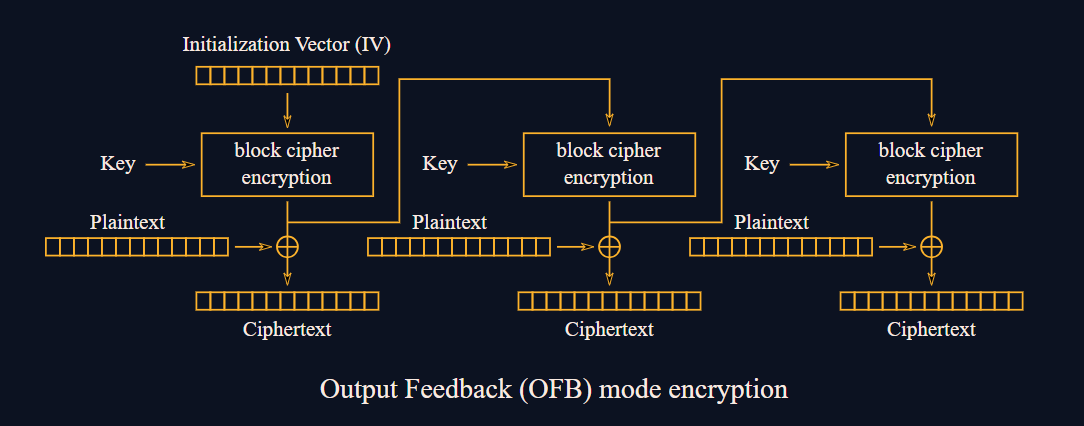
AES-OFB works by encrypting the IV, XORing it with the plaintext, and repeatedly encrypting the IV for each subsequent block.
Vulnerabilities
Chosen Plaintext Attack
Chosen Plaintext Attack for OFB relies on the vulnerability where the user is allowed to supply their own IVs. As in OFB, the plaintext does not go through the AES encryption algorithm, instead we encrypt the IV which is never revealed to us. In order to recover the encrypted IV, we simply need the original plaintext and its corresponding ciphertext given an IV.
\(\text{ENC IV} = \text{AES}(\text{IV})\)
\(\text{CT} = \text{PT} \oplus \text{ENC IV}\)
If we are given the ability to encrypt a chosen plaintext with a chosen IV, we can choose a random plaintext as long as we know its initial content, and the IV that was used to encrypt the flag.
We can then find the encrypted IV by performing: \(\text{ENC IV} = \text{ENC PT} \oplus \text{PT}\).
Using the known encrypted IV, we can recover the flag: \(\text{FLAG} = \text{CT} \oplus \text{ENC IV}\)
AES-CTR
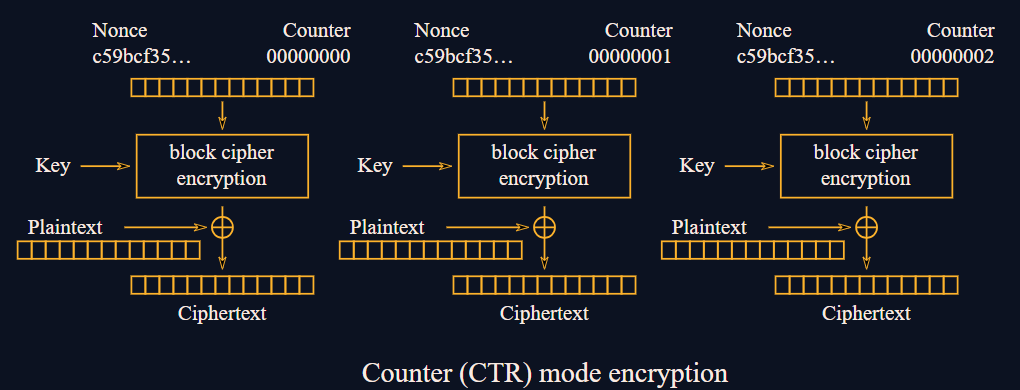
AES-CTR works by concatenating a simple counter to the end of the IV before encrypting it. We then take the result and use it to XOR our plaintext to encrypt it.
Vulnerabilities
Known Plaintext Attack + Nonce-Counter Reuse
If Nonce-Counter reuse vulnerability, this means that the encrypted IV-Counter will be the same for all blocks. If we know part of the plaintext, we will be able to obtain the encrypted IV-Counter by XORing the known plaintext block with the first block.
\(\text{ENC-IV-COUNTER} = \text{PT1} \oplus \text{CT1}\)
Known Plaintext Length
AES-CTR is a stream cipher which means that the length of the ciphertext is equal to the length of the plaintext. This is especially vulnerable when the encryption algorithm uses a compression algorithm to compress the size of the flag. If the encryption system allows data to be appended to the flag before compression, we can use the length of the ciphertext to deduce if our guess of the flag is right as the repeated blocks of characters tend to result in a shorter compressed length than random characters of the same length.
Keystream Reuse Vulnerability
Keystream Reuse Vulnerability allows for an attacker to use crib draggin which is basically guessing one side of the plaintext and being able to recover both plaintexts at once AND being able to recover the keystream.
\(\text{CT1} = \text{PT1} \oplus \text{K}\)
\(\text{CT2} = \text{PT2} \oplus \text{K}\)
\(\text{CT1} \oplus \text{CT2} = \text{PT1} \oplus \text{PT2}\)
We can guess one side of the plaintext and be able to recover both, using context or statistical analysis.
AES-CFB8
AES-CFB8 is known as a Cipher Feedback Mode 8-bytes, which encrypts the IV or previous ciphertext and XORs the current plaintext.
Vulnerabilities
CVE-2020-1472
CVE-2020-1472, also known as ZeroLogon, is a vulnerability in AES-CFB8 where if the IV is zeroised, the feedback loop is very predictable.
DES
To be added
ChaCha20
To be added
ARC4
To be added